Learn music theory by hearing what you are reading.

Every chord, interval and progression here is an object: click it and it sounds, appears on the staff and lights up on your instrument. The topics work this way. So do the lessons.

A real passagefrom the topic Secondary dominants, and the chord that arrives a bar early · an 3-minute read · free

In a song in C major, the chord should not exist. The scale has no , and the fifth degree of C is . And yet it turns up constantly — almost always right before .

The reason is simple: is the dominant of . It is not serving the key, it is serving the next chord. The tritone it carries, –, resolves by contrary motion — and the ear does the rest on its own.

Click any symbol in the text to hear it. No images: every object is computed by the core and knows which concept it belongs to.

Two ways to learn here

The same material, two routes. Switch whenever you like — nothing is locked behind a level.

In order

subscription

9 courses, 62 lessons. Each lesson closes a loop: read, see, hear, do and practise — and it is only finished when its exercises are.

  1. Notes have names, and the names have a ruleTwelve sounds per octave, seven letters, and the keyboard as the place where the distance between two neighbours is always the same.
  2. Counting timeEach note value is half the one before, the bar groups the pulses, and counting out loud comes before reading anything.
  3. The distance between two notesAn interval has a number, which comes from the letters, and a quality, which comes from the semitones; the ear learns both.

… and 5 more lessons in First steps in theory.

See the syllabuses

By curiosity

free

120 topics and a glossary in three languages. Start at a term you do not know and follow the links — every text says what to read before it and what comes after.

  • Bossa nova harmony, and a wider vocabulary for the same grammarExtensions as the norm, frequent modal interchange, chained II–V–Is and voice leading that barely leaps; it is functional harmony with more vocabulary, not another harmony, and analysis by degree still holds.
  • The blues scale, and the note that is only for passing throughThe minor pentatonic with one note added, the diminished fifth between the fourth and fifth degrees; it sounds good while it moves and harsh if you stop on it, and that is what makes the blues sound like the blues.
  • Secondary dominants, and the chord that arrives a bar earlyChords from outside the key that work as the dominant of a degree that is not the first, and why they make the next chord sound inevitable.

… and 117 more topics, besides the glossary, the repertoire analyses and the timeline.

Open the encyclopaedia

What comes before what

Each of the 120 concepts declares its prerequisites. That is what generates your path, the suggested reading inside each text, and the map of what you have mastered. No topic here is an island.

120 concepts · 120 topics · 62 lessons · 6 tools

Tone andsemitoneIntervalqualityMajor scaleTriadsDiatonicharmonyChordinversionsSecondarydominantsModalinterchange

And make it stick

Reading understands; only a trained ear recognises. Exercises are scheduled by spaced repetition against the concepts — not “you practised today”, but “your descending minor sixth has been weak for three weeks”.

Interval recognition · a sample

Which interval is this, descending?

In practice, the question is generated and judged on the server: the browser receives the sound, never the answer. That is what makes the mastery map trustworthy rather than decorative.

And when you get one wrong, the explanation names the specific confusion and links to the topic that undoes it.

subscription 11 kinds of exercise · mastery map · history across devices

Take all this into your AI

Chords that play and ear training inside Claude, ChatGPT and Grok, computed by the same engine as this site.

See how to use it
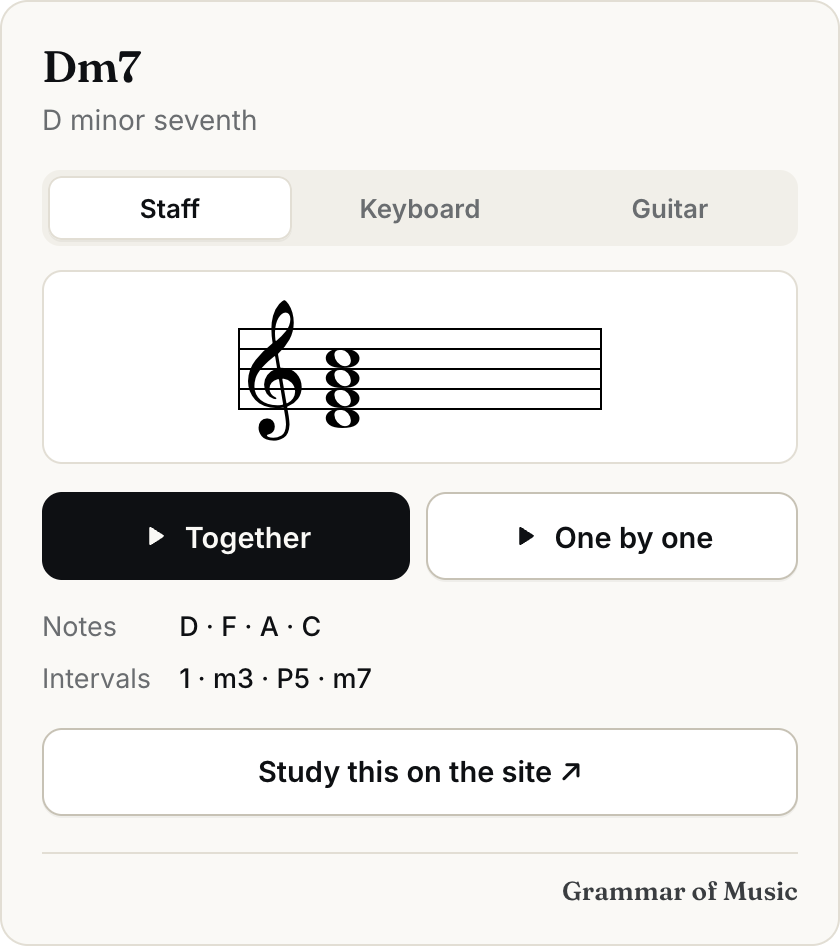
The Dm7 card inside the conversation: the chord on the staff, buttons to play it, its notes and its intervals.

Tools, for when the question is a one-off

They are not the product — they are the support. They answer a question in the middle of a study session and get you back to the music. No account, and an address of their own per chord and per key.

  • Chord dictionaryAny chord symbol: the notes it names, the staff, the keyboard, the shapes on the guitar neck — and the sound.
  • Harmonic fieldThe chords a key is built from, degree by degree, with the function of each one and the sound of all of them.
  • Circle of fifthsEvery key arranged by the fifth that separates them, with its key signature, its relative minor and its neighbours.
  • TransposerA chart moved to another key, with the spelling that key actually uses rather than the nearest black note.
  • Temperament comparatorThe same note in different tunings, in cents and in sound: what equal temperament costs and what it buys.
  • Progression analyserA sequence of chord symbols read in a key: degree, function, and what each chord is doing there.

What is free, and what the subscription adds

Every course syllabus is public. You see exactly what you would be getting before you decide.

Always free

  • 120 topics, every musical object audible
  • A glossary in Portuguese, English and Italian
  • 3 repertoire analyses, in full
  • All 6 tools, no account
  • The syllabus of all 9 courses
Start without an account

With a subscription

  • All 62 lessons of the 9 courses
  • Exercises with spaced repetition, judged on the server
  • The map of what you have mastered, what has cooled and what you have never seen
  • The tutor, for the question the topic did not answer
  • Your progress kept across devices
See the subscription

From the same author